Workflows as a Service for medical practices — and the vendors that support them.
Every vendor a practice depends on, working from one set of records.
A practice runs on eight functions and a dozen outside parties — accounting, billing, IT, legal, marketing, staffing, supplies. Jubilee Health reads the systems it already runs and gives each of them a view of the same records. Nothing is re-keyed between them, and every figure shows where it came from.
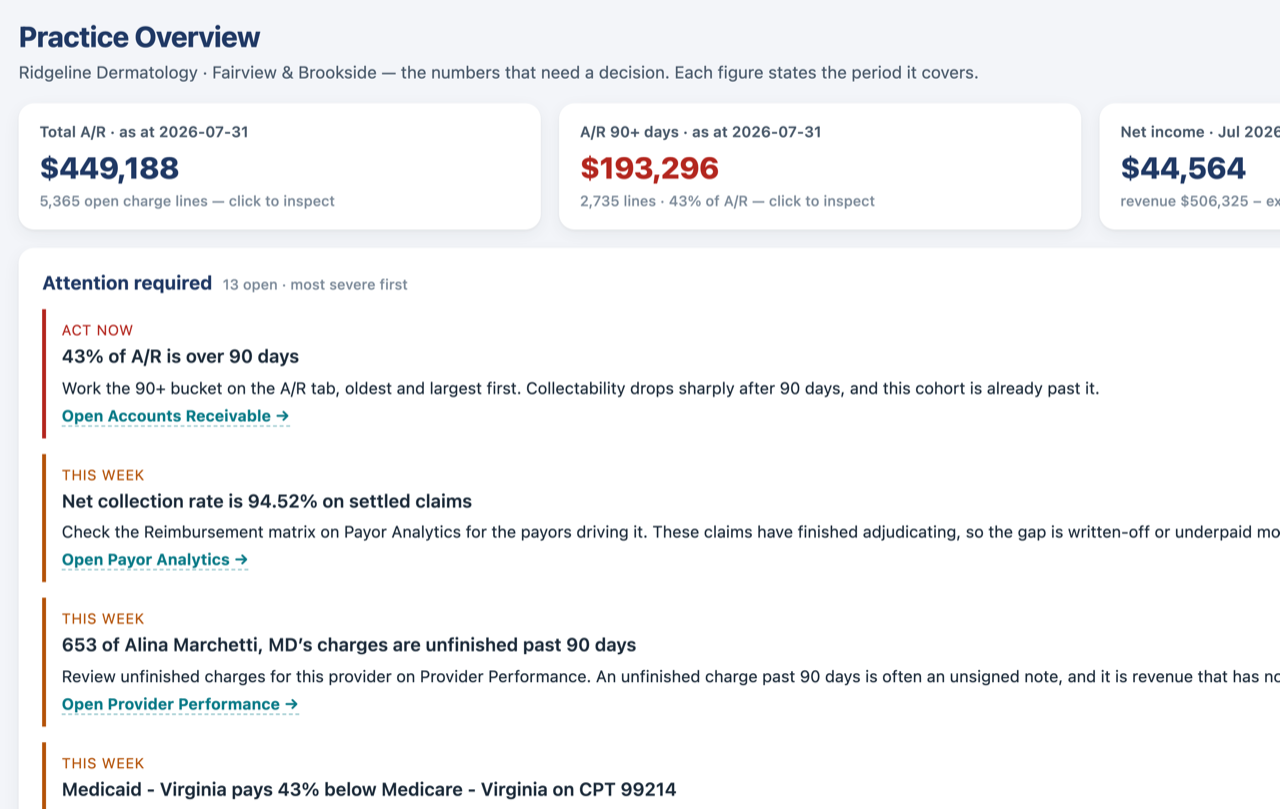
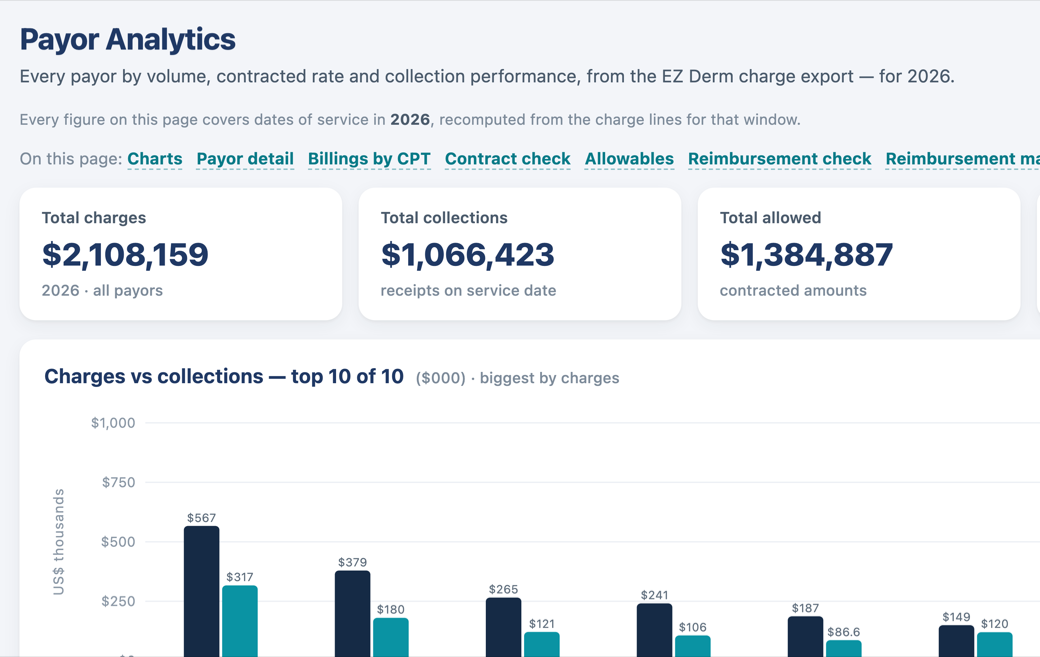
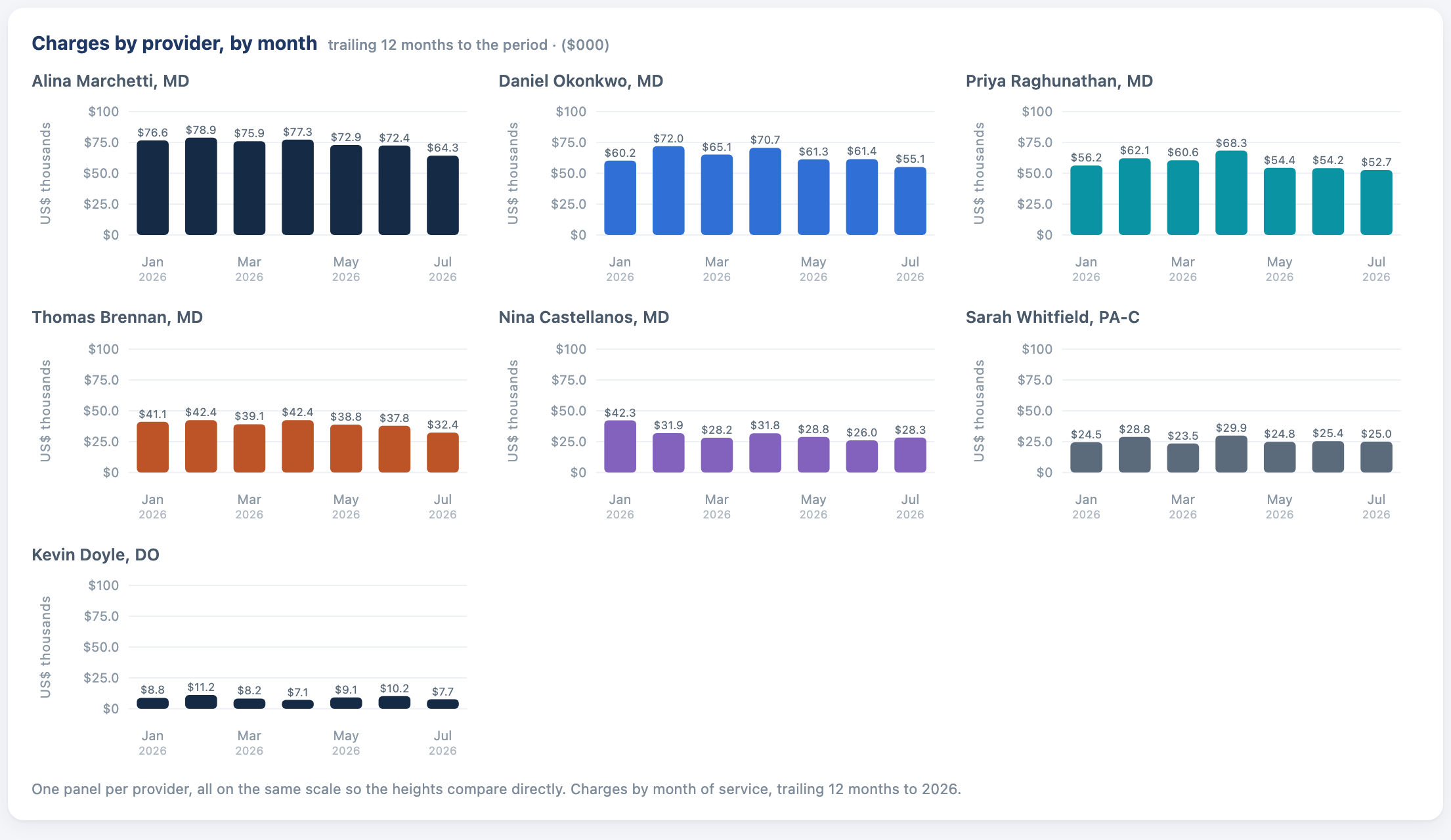
Practice overview, payor performance and per-provider charges — demonstration data.
The network
The practice at the centre. Everyone it depends on, around it.
Each party signs in to a view of its own, and all of them work the same rows — so the request the firm sends is the request the practice answers, and the ticket the IT provider works is the one the practice raised.
Why it compounds
Six parties is fifteen relationships. One hub is six.
Every pair that has to reconcile by email, spreadsheet and phone call is a place where two versions of a number exist. Adding a vendor to a practice today makes the problem worse. Adding one here makes the picture better.
Who it's for
Nine seats. Find yours.
Each seat opens on its own work, not on a general-purpose dashboard with permissions bolted over it. The practice owns the records and approves every connection. Seats are opening in order — tell us which one is yours.
Practice owners & managers
See what you are owed, what it cost, and what to do about both today — without becoming an analyst.
Join the waitlist →MSOs & groups
Every member practice on one chart of accounts, with the variances converted into annual dollars.
Join the waitlist →Accounting firms
Your whole client book in one workspace, and a month-end that closes on evidence instead of email.
Join the waitlist →Billing companies
Both sides of the practice in one place, so payments, deposits and remits tie out for real.
Join the waitlist →IT providers
The onboarding pipeline and the request queue, with an age on every stage and an alarm past fourteen days.
Join the waitlist →Legal counsel
Agreements, BAAs and review dates, sitting next to the records and relationships they govern.
Join the waitlist →Marketing
Spend measured against arrived patients and first-year receipts, not against clicks.
Join the waitlist →HR & staffing
Headcount, credential expiries and payroll burden read against what the practice produced.
Join the waitlist →Supplies & inventory
What is on hand, what expired, what is at or below cost, and what it runs per visit.
Join the waitlist →What changes
What everyone stops doing.
Re-keying the same number into three systems
The request the firm sends is the request the practice answers. The ticket the IT provider works is the one the practice raised. Both sides read identical figures, so nobody reconciles two versions of the truth.
Asking where a number came from
Every figure carries its source extract and its as-of date, and clicking an aggregate opens exactly the rows it counted. When something is not known yet, the page says so instead of showing a zero.
Hunting for what needs attention
Follow-up, unsigned notes, patient recall, document requests, deadlines and IT tickets each arrive as a queue with counts, owners and ages. The day starts with a list rather than a search.
Leaving money with the payor
Allowed amounts checked against your own fee schedules, so a payor drifting below contract is a report rather than a suspicion. Unbilled revenue sitting in unsigned notes, and A/R past ninety days, both come with a worklist.
Workflows as a Service
One balance, across four seats, without a single handoff email.
This is what the name means. A workflow starts in one seat and finishes in another, and the record travels instead of the message.
The charge lands with its provider, service date and CPT.
Worked from the same charge rows the practice can see.
Allowed, paid and adjusted, back against the original charge.
Allowed checked against the fee schedule. A drift below contract is named.
Composed from the balance, checked against the opt-out register — and held for a person to approve.
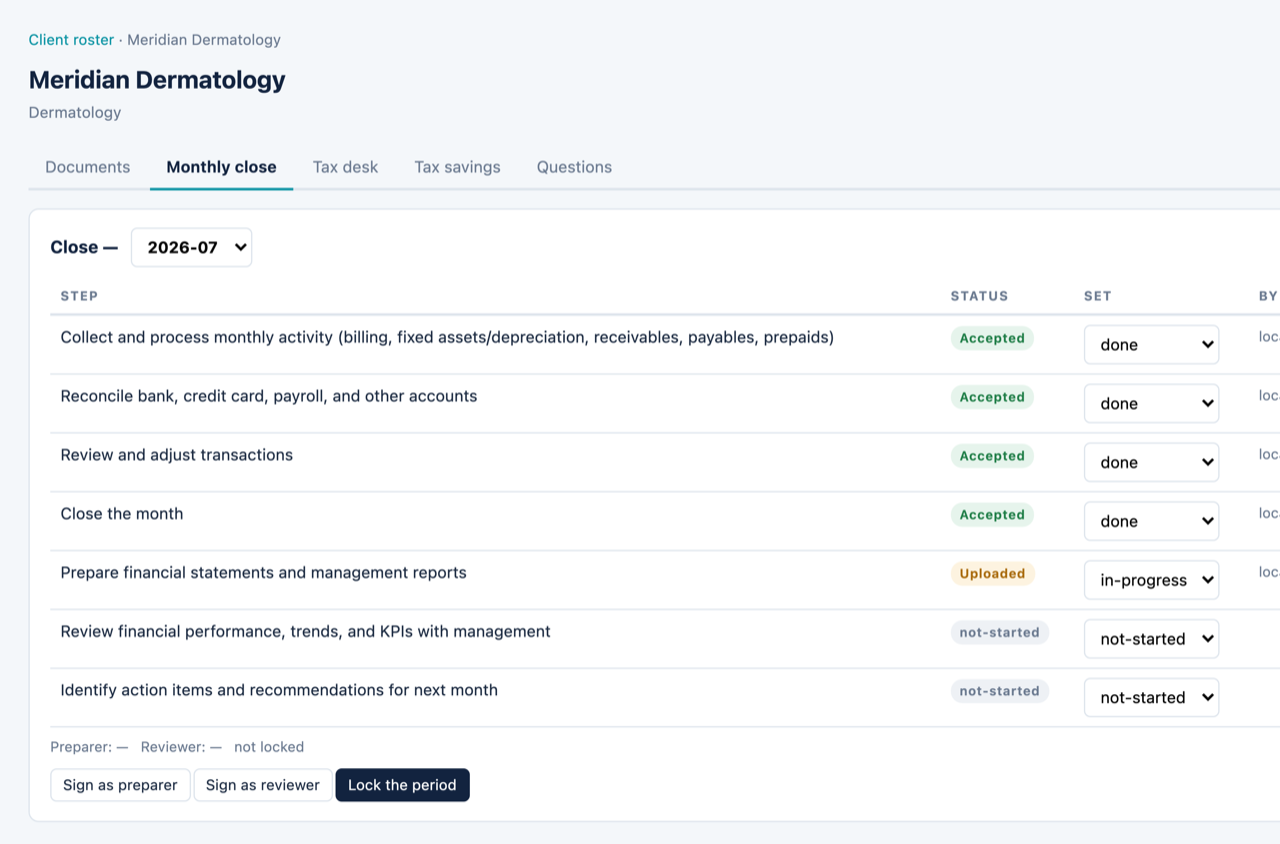
The month-end close, worked by the practice and its accounting firm in the same place — evidence attached per step, preparer and reviewer sign-off, and a locked period once it is done. Demonstration data.
The grounding rule
Every number shows its work.
Dashboards fail when nobody trusts the figures. Each one here carries the file it came from and the date it was pulled, and clicking it opens the records underneath.
That standard binds the AI too. Recommendations cite the rows behind them, drafts wait for a person to approve them, and anything a model wrote is labelled as drafted rather than passed off as measured.
Collections, trailing 12 months
$2,847,310
Opens the 4,212 payment lines this figure counts
Demonstration data.
Security
Built to HIPAA and SOC 2, and enforced in the product rather than in a policy document.
Letting eight outside parties near a practice's data is only safe if the platform itself refuses what the paperwork forbids. Around ninety controls across eight domains, mapped to HIPAA, SOC 2 and NIST 800.
Access
- Single sign-on, or a password with a mandatory second factor, behind a fail-closed allowlist
- A role-by-capability-by-practice authorization matrix across sixteen capabilities, pinned by test
- Per-practice grants with an explicit sharing scope, and an entitlements layer that can only narrow access, never widen it
- Cross-tenant access without a grant is refused and audited. A twelve-month review date sits on every relationship, and nothing revokes itself
Patient data
- A Business Associate Agreement gates every connection carrying patient data, and it is a record the practice executes itself
- The accounting firm's view is de-identified by construction — no names, no dates of birth, no dates of service, no diagnosis codes
- Routes carrying patient data are separated by class and refused outright unless the instance is enabled for it
- Aggregates are collapsed below a floor so they cannot be differenced back to a person, and sensitive identifiers are dropped at the ingest adapter
AI
- Every AI feature runs through one boundary that redacts patient-level detail before anything reaches a model
- A source check fails the build if an AI call is moved outside its route guard, so the boundary cannot be broken by a refactor
- Nothing reaches a patient or a referrer without a named person approving it. Every draft carries its approver
Platform and evidence
- An append-only audit trail on every access decision
- A content security policy without eval, a cross-site write guard, atomic writes, and an upload allowlist
- Before every release, an automated gate signs in as each role and sweeps every view, so a permission regression cannot ship
- Per-practice storage mirrored to cloud storage with backups, and a durability check on every new source. A practice that leaves loses a lens, not its books
Join the waitlist
The first cohort is free. The seats are filling.
Tell us which seat is yours and we will open it in order. It costs nothing, and no connection between two parties is ever charged for.
We will use what you send to contact you about the pilot, and for nothing else — no list, no sharing, and we delete it whenever you ask.
You are on the list.
We have your seat recorded and will be in touch as it opens. Nothing else happens until then.